The monument has always been a technology of authority. Raised above the body, cast in enduring materials and positioned within public space, it seeks to transform particular histories into permanent truths. The monument promises stability. It attempts to arrest time.
Un-Becoming Monuments begins where that promise starts to fail.
For many years, through multiple mediums, I have sought to expose the assumptions and systems of power embedded within representational traditions. The works brought together in Un-Becoming Monuments continue this investigation by focusing on processes of transformation, instability and decline. Rather than celebrating permanence, they reveal the monument as something contingent, vulnerable and subject to continual revision.
The title Un-Becoming Monuments carries a deliberate double meaning. While it describes monuments undergoing a process of dissolution and transformation, it also recalls the language of social judgement. To be “unbecoming” has historically implied a failure to conform to accepted standards of behaviour, particularly for women. Likewise, the word “brazen” in the sculptural work Brazen Heads evokes both the materiality of bronze and the transgressive figure of the woman who speaks too loudly, too publicly, or with excessive authority. Within the exhibition these terms are reclaimed, transforming what might once have functioned as criticism into a position of resistance and irony. Un-becoming becomes an active refusal of fixed identities, prescribed roles and inherited forms of authority.
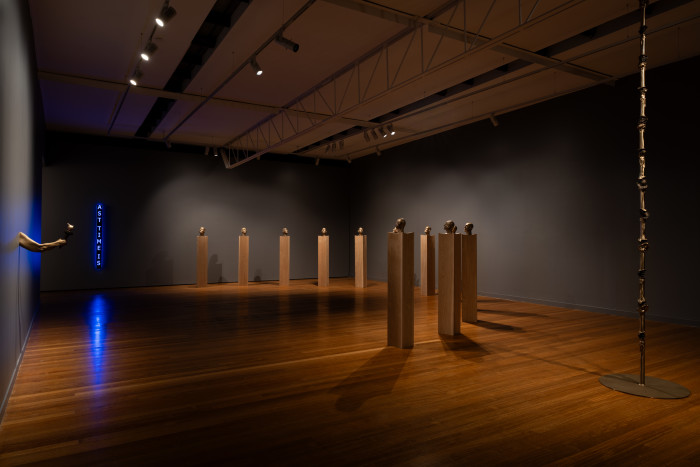
At the centre of the exhibition is Brazen Heads. Each head is cast from the one before it, producing a gradual reduction in scale as the bronze contracts during cooling. Repetition becomes diminishment. Reproduction becomes erosion. The very process intended to preserve an image simultaneously initiates its disappearance. Here the self-portrait occupies a paradoxical position. Through the alchemical qualities of the bronze, identity appears as reductive, reproducible and continually transformed. Each casting is both a copy and a difference; each iteration moves further from an imagined original.
Brazen Heads recalls the legendary automaton the Brazen Head of the Middle Ages whose ownership was ascribed to medieval scholars. This artificial speaking head was reputed to possess prophetic powers that enabled it to correctly answer any question put to it. Existing somewhere between sculpture, machine and oracle, the Brazen Head occupied an uncertain territory between knowledge and belief, prediction and authority. Ironically, it’s only purported utterance; “Time is, time was, time is past”. Unlike this singular prophetic voice, Brazen Heads is neither fixed or singular. Each head can be manually rotated, allowing the installation to generate changing configurations. The work invites viewers to imagine the fleeting conversations and shifting alliances of the group rather than a single authoritative voice.
The concerns that animate Brazen Heads extend throughout the exhibition. In the photographic series Un-Becoming Monuments, the body enters a shifting relationship with the bronze heads. It appears alternately to support, animate, carry, resist and mourn them. At times the heads resemble relics, offspring, monuments, masks or remains. No fixed narrative emerges. Instead, a series of provisional encounters unfolds between flesh and bronze, living body and sculptural double.
While Brazen Heads focuses on repetition, erosion and the instability of representation, other sculptural works examine the symbolic structures through which authority is sustained. In Liberty at Half Mast, a bronze arm projects from the wall, holding a bronze cast of the torch from the Statue of Liberty. Detached from its monumental body, the torch appears suspended in a state of uncertainty. The work invokes the visual language of commemoration, freedom and national aspiration while simultaneously undermining its heroic certainty. The title suggests mourning, diminishment and the lowering of collective ideals. Removed from its original context and supported by a solitary arm, liberty appears not as a triumphant condition but as something fragile, contingent and perpetually in need of support.
A related tension is present in Power Climber, a four-metre bronze pole marked by a sequence of negative casts of hands ascending its length. The sculpture records the labour of climbing while withholding the climber’s body. What remains are traces—absences that signify effort, ambition and persistence. The work evokes the vertical aspirations embedded within monuments and systems of power yet replaces declarations of achievement with evidence of continual striving. Power is not represented as possession but as an ongoing and uncertain negotiation.
Historically, monuments have overwhelmingly celebrated military, political and patriarchal authority. They function not simply as records of history but as instruments through which cultural values are maintained and transmitted. By presenting the monument as vulnerable, shrinking, fragmented and contingent, the works in
Un-Becoming Monuments unsettle those traditions. They refuse heroic certainty in favour of instability, process and transformation. What emerges is not the destruction of the monument but its unravelling.
–Julie Rrap
View exhibition


- About
- Subscribe

