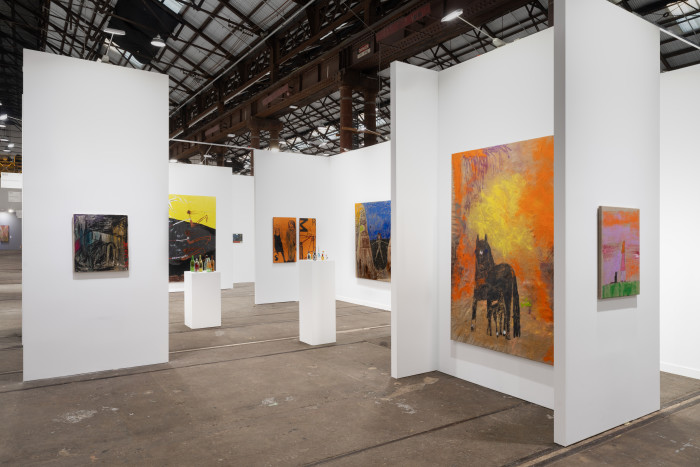
Roslyn Oxley9 Gallery is delighted to present two leading Australian artists, Jenny Watson and Mia Boe at Sydney Contemporary 2026 in a dynamic exhibition spanning generations. Drawing on personal history, imagined worlds and inherited narratives, both artists use painting as a way to tell stories, to reshape them and, sometimes, to turn them on their head.
Jenny Watson (b. 1951) has been telling stories of her own life – the mundane, the fictitious, the hyperbolic and the absurd – through painting since the 1970s. At a time when the Australian art world was still overwhelmingly male, Watson was tenaciously depicting her own experience as a woman. She credits her encounters with feminist art theorist Lucy R. Lippard in the 1970s, as an important reinforcement of her belief that personal imagery was valid subject matter for her art.
The works presented here span more than four decades of Watson’s practice, from 1985 to 2026, bringing together many of its defining hallmarks. One might call it her best in show. Naturally, the horses are here, alongside self-portraits and alter-egos, suburban dreams and everyday anecdotes and her signature combination of image and text. There is a punk-sensibility too: a certain grit, humour and DIY spirit that has remained central to Watson’s visual language.
Across the booth, Mia Boe (b. 1997) brings a different kind of storytelling to the canvas. A Melbourne-based painter of Butchulla and Burmese descent, Boe draws on personal heritage, art history, social realism and surrealism to explore the cultural dislocations produced by colonisation and political conflict.
At Sydney Contemporary, she presents a new body of work that looks to the history of the opium trade along the Silk Road from India to Burma in the 19th century, while considering the workers whose labour and lives made that history possible. Importantly, Boe also brings to light the devastating impact of opium on Indigenous communites during colonisation and it’s lasting impact in Australia today. Yet these paintings are far from conventional historical scenes. Boe’s vivid colours, strange figures and surreal juxtapositions give the works the feeling of an imagined world where history, memory and fiction can overlap. Boe’s paintings ask whose stories are remembered, whose labour is visible and how histories continue to move through generations.
Seen together, Watson and Boe demonstrate the extraordinary range of what storytelling through painting can do. As ever, Watson turns inward, transforming personal experience and memory into imagined worlds, while Boe looks outward and across generations. Both understand painting as a place where stories can be remembered, embellished, questioned and made anew.
–––
As part of Installations at Sydney Contemporary, Roslyn Oxley9 Gallery is pleased to present two major projects with Mike Hewson: a takeover of the Sydney Contemporary Café and a whimsical fountain sculpture installed on an expanse of flooring inlaid with tile shards and found objects.
Mike Hewson is an Aotearoa-New Zealand born artist whose practice engages sculpture, architecture, public space and urban infrastructure. His works often intervene in built environments, creating situations that recontextualise how people move through, use and understand shared civic and social spaces.
At times anarchic, at times classical, the installation presented at Sydney Contemporary demonstrates Hewson’s bold, ambitious practice that encourages viewers to step into a space of play and participation where sculpture, design and community coalesce.
Grounding Hewson’s installation is Piet Pavers - a collection of intricately mosaiced floor tiles flecked with wood, gold and precious stones that fit together like a puzzle in the French paving pattern. Each paver is wittily inlaid with playful objects such as keys, vintage phones, dominoes and other found materials. As individual artworks, each paver contains its own medley of objects and composition. Collectively, their harmonious modularity calls on Greco-Roman architecture whilst also operating as functional flooring.
Perching atop the Piet Pavers is the Frog pond fountain stack. The sculpture emulates the beauty of classical fountains where instead of marble, the structure’s base is made up of salvaged concrete panels from the iconic Sydney Opera House. Water cleverly recirculates from the top of the fountain, pouring into a pond created for actual frogs - complete with fairytale green lily pads - to create an unexpected moment where nature, the civic environment and formal architecture integrate with the art fair.
Fresh from transforming the Art Gallery of NSW’s iconic Tank with The Key’s Under the Mat, Hewson has revamped the fair’s cafe into the Pit Stop Café - a sculptural meeting place that is part artwork, part social space where we can eat, drink, connect and gather. The Pit Stop Café takes elements from the Tank installation, including bucket seats and the service counter as well as a newly created marble ‘rug’, to create an intervention that allows us to see wonder in the everyday.
–––
As part of Installations at Sydney Contemporary, Roslyn Oxley9 Gallery is excited to present new works by Kirtika Kain, alongside her immense material painting Midnight (2025), recently exhibited in the 2026 Adelaide Biennial of Australian Art: Yield Strength.
Kirtika Kain is an artist and educator born in New Delhi and based in Sydney. Her practice combines elements of sculpture, experimental printmaking and painting, drawing on her Dalit lineage to investigate material histories, ancestral memory, anti-caste thought and the complexities of race and caste in the diaspora.
Kain, who moved to Sydney when she was three, is part of the Dalit diaspora, a member of the vast community of around 200 million people once deemed “untouchable” under India’s caste system and still subject to persecution. Kain’s chosen materials often have deep connections to ritual, labour and the social hierarchies that have shaped the lives of Dalit communities. Pigments, waxes, cotton, grains, gold, copper, tar and hessian are brought together by Kain through a labour-intensive process, producing works that operate as archaeological vestiges of histories and experiences that have often gone unrecorded.
Tar and gold, in particular, carry complex associations with labour, value and caste. These material and symbolic associations come together in Midnight, where tar, gold and blue pigment converge. The work was made by taking silicone moulds from paintings in Kain’s studio and recasting their surfaces in tar and hessian, producing a vast, dark field assembled from repeated fragments. Flecked with blue pigment, a powerful symbol of Dalit resistance, Midnight holds a commanding tension between weight and expansiveness, density and light. Here, surface becomes an archive: a place where memory, inheritance and resistance gather.
View exhibition


- About
- Subscribe

