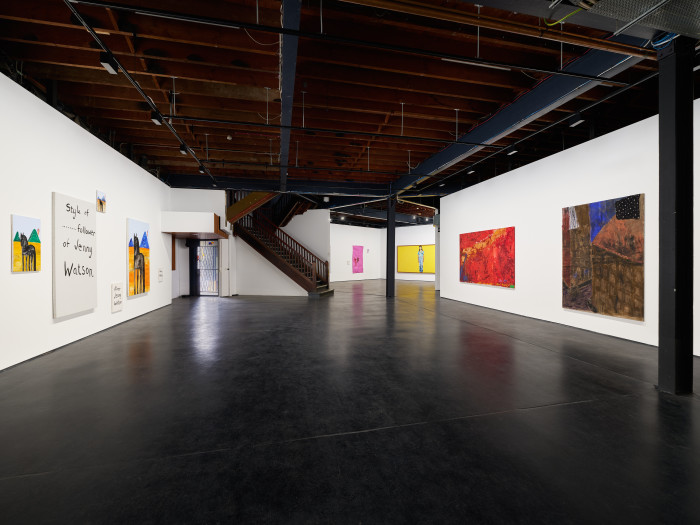
All images courtesy of Fiona and Sidney Myer Gallery. Photography: Christo Crocker
Jenny Watson is one of the most accomplished and celebrated artists to graduate from the National Gallery School (which later became the Victorian College of the Arts). Her extraordinary contribution to contemporary art is recognized through major surveys of her work in Australia and inclusion in important curated exhibitions across Europe and America. The works for Possibly Perpetuating Pop, Personalism, Post-Punk and Post-Conceptualism: 7 Decades of Jenny Watson, her first solo exhibition at the VCA, have been specially selected by Jenny and Associate Professor David Sequeira. Focusing on the two themes of the lone figure and the horse, the selection reflects concerns that have remained central to her practice over the last seven decades. The following text is a conversation between Jenny and David at Jenny’s studio in August 2026.
DS: There is a sense of despondency in your 1986 painting ‘Australian artist in a bar in New York, 2016’. A single tiny figure sits atop an impossibly tall stool, the body stretching out to the bar towards the seemingly unreachable glass. The cavernous room is a field of luscious reds punctuated by the blue and green figure that is pushed to one side of the composition.
JW: In the 80s, when I was looking towards working overseas, New York was the ultimate dream for a lot of artists. People would go there and not be able to get interviews with galleries and not be able to make any headway. The figure is depleted.
DS: Although the work was made in the 1980’s, its title, (included in text in the painting itself), includes the date, ‘2016’.
JW: Yes, because it's projecting as to what might have happened by 2016.
DS: So, in the 1980s you're projecting that in 2016 that you're still going to be slumped over a bar?
JW Yeah, exactly. I mean it'd be interesting to find out the statistics on... Australian artists who had tried to make headway overseas. You'd never find out because people would not be completely honest about how many times they'd been knocked back so it's impossible to find out. But let's say very few Australians get the chance to make a dent in the Northern Hemisphere art scene.
DS: In the exhibition there are several horse paintings. This is such a persistent theme for you… it's from the early days right through to now. I'm talking to you at your property and I’m looking out onto your horses. Can you share a little about …
JW: The horse thing?
DS: Yes, your relationship with horses.
JW: Well, my father bought me a pony and then a big horse when I was sort of around 12 years of age. He was one of those fathers who saw that the passion was there and it couldn't be ignored. We knew nothing about horses. The big horse was an ex-pacer from Adelaide but fortunately a wonderful big quiet horse that I never had a tumble from… and we're talking about hooning through Sherbrook Forest over old mossy slippery bridges… and oh he was incredible and I never had to go home and say oh Mum and Dad I've broken my arm. He just looked after me.
DS: What about having horses as an adult?
JW: In 1982 I went out and bought a horse and fortunately he turned out to be a wonderful thoroughbred who had raced. By complete fluke, a Danish Grand Prix professional rider came to our stables for a six week holiday just to see what the equestrian scene was like in Australia. I discovered what dressage was…you know…the real fine tuning gymnastic training of a horse…and got into it with her. She's gone back to Denmark now but she became a friend and a mentor. She helped me find some good horses to compete. I competed to medium level, which is not bad. And yeah… I did the whole horse thing as much as I could as a sideline to my work. I found it was great to be outside and great to meet different people. We had a group of five women who'd all sort of done the same thing- bought a horse in our early 30s…and we're all learning. We're on a very steep slope learning about dressage. And yeah… it's been part of my life since then.
DS: And what about the transfer of this interest? What about the relationship between horses and painting?
JW: I had images of horses around me all the time…it became very inspirational. I also read an article in those early days by an English writer called Geoffrey Hattam who was also a sculptor. And he said that riding correctly is an art form because you are changing the shape of the animal. You're actually drawing the muscular structure and improving it by the gymnastic exercises in riding. So he saw the horse as rawmaterial for his sculpture. And yeah, I remember thinking… there's something there.
DS: How was that influential for you?
JW: I remember thinking, well, here's a sculptor, here's an artist who understands what I do professionally. Conditioning a horse is quite fascinating because you can find a horse that's in very, very bad condition…no muscle, no fat, lost all their gleam in their coat and by feeding and training, you completely change that animal. People who can do that are really respected because a lot of the equestrian scene is people just paying big money for a product that's already perfect. But to actually make that perfection from raw material is really fascinating.
DS: Dressage is so fascinating because, you're impacting behaviour through domination and submission. I mean, even the term ‘harness’ is a noun, but it's also a verb where you harness something. I often look at the horse and the rider and think, well, who's the boss of whom?
JW: Well, a horse is usually a 600-kilo animal, so you have to get a relationship going where you're respected. It's sort of like weights and measures really. Your weight in the saddle and your very sensitive handling of the bit which is in the horse's mouth… it's the combination of that, you know, which are called the aids…but it's a combination of that that allows it all to happen. And some horses are more talented than others, so they can perform those movements more easily. It’s a very interesting activity.
DS: Is there a connection between dressage and painting?
JW: Making paintings is a very elegant procedure. It's like picking up a beautiful piece of fabric and making a clothing item from it, like Martin Grant does. What happens to that piece of fabric as a kind of alchemy. And that's what happens with stuff that you squeeze out of a tube and make images. There really is a huge magic to it. I went to oil painting classes at age 12, so I've been involved in it sort of over 60 years. So I feel I can say that with some authority.DS: Yes, let's talk about those 60 years or 7 decades. I look at some of the works from the 70s, which have a photo realist quality. As we progress into the 80s and 90s the works, I want to bring in the term drawing, because there's a sketchiness to them. The colour has a lot of air around it. You let the support, whether its raw canvas, upholstery fabric, or dress material…you let that into the image. It almost as if you give the paint some air.
JW: That's exactly right. You have to let it breathe. And when I'm teaching, I can't stand students just covering the whole thing as though it's, you know, with a sort of palette knife, you know, so it's like the whole thing has to be covered. You have to have air and you have to let the canvas breathe through. Yeah, that's very much part of what I do.
DS: Thinking about Yellow painting: John 1974 and Brown Horse with Yellow/Green Headband 1973, what did you learn from making and showing these works?
JW: I was looking at beautiful pictures in racing magazines…just beautiful…the beauty of the coat and the shape. And so that show at Powell Street Gallery in '74 was seven or eight life-size horse paintings, which I think would still be a good show today. You walked into the gallery and it was like being in a stable. But what I learned from painting from these beautiful photographs of racehorses was that it was kind of a landscape. It was within the shape of a horse, but the actual painting was like a landscape… beautiful dark shadows and then lighter glossy bits and then tiny bits of detail for hairs in the mane. I just can't tell you how much I learned from that…you know… painting eight of them. It was a year's work and I was teaching high school full time. I can't believe that I painted the horses show that was shown in '74. I would have just turned 23.
JW: When I painted Yellow painting, I was very conscious of large abstract paintings, particularly in New York and locally. People like Robert Jacks, Michael Johnson, Sandra Leveson. I was interested in abstract art. I wanted to make a large painting that brought in the abstract power of a 12 by six piece of canvas and bright yellow but then combine it with a realistic skill figure painting. When I think back to the age of 23, I was setting myself some tough goals.
DS: For me, this is the exciting part about your practice. I don’t think you haven't stopped setting yourself goals. It occurs to me that you're always growing and learning.
JW I want to learn from the experience of the work I make. I don't ever want to think, right, that's what I do. I can do that. I can sell it. I can have a great life. I just find that would be the most boring way to be an artist. So I'm always testing the boundaries. The separate text panels, the little objects on shelves. and the unstretched paintings that just hang like a curtain…all these are to do with my questioning of what is a painting? Does it have to be oil? Does it have to be framed? Does it have to be done on an easel? No, no, no, no, no, no, is my answer.
DS: Across the decades, your work points towards the idea of deconstructing what painting is, what art is, what it can be.
JW: Yes, that's right. Well, don't forget conceptual art was sort of being announced in about '71 my second year of art school. People doing things that were deconstructed…earthworks in the desert. I mean, it was a very exciting time to look at art and sort of say, what is art? You know, what actually is it? All of that influenced me, but I found out from that too, that I was a painter.
DS: Tell me about the space in which you work?JW: Why don’t we walk down to where I work. (Jenny and David leave the deck and walk down to an open air space below the house) I'll give you a look at the studio from this angle because this is the best way to understand it. There's all the horse feed. People find it hard to believe I send work overseas from here. This is all horse stuff, and we had a cyclone through there which we haven't attended to yet. This is where I work. Everything is done on this table. The work that I send overseas, no matter what the occasion, regardless of whether it’s a really big deal or really small deal, it's all done here. People find it hard to believe that I don't have a big fancy studio. I'm just starting to experiment with toys. One of my shows coming up will be toys on shelves with a painting. So that's what's here. But it's all done here and I quite like it. I'm outdoors, I can see horses. If it's really windy and really stormy, a bit of rain does come in, but it's no big deal. What do you think?
DS: I think it's really special. I'm standing here with Jenny Watson at her work table looking out athorses….breathing in the outdoors. I get it. It’s basically a shelter with no walls where you can see and paint horses.
JW: Yes, it really works, although you can see it's very messy, it really works. Trucks can come here to pick up work. I can work here, I can also work upstairs in the living room, we've got storage. It really does work in a very ramshackle way. DS: Tell me about what your day looks like.
JW: I work alone and I don't have music or anything, I put a two-hour or three-hour limit on work. I think, for me, focus runs out after that. And then I'll go upstairs and make my lunch, have a glass of red wine and watch a midday movie.
DS: Who are the artists to whom you have looked in relation to your own work?
JW: Well, in high school, I loved Henri Rousseau. My high school art teacher, David Williams, used the school budget to import the magazine Studio International by air to my high school in Box Hill. We had an art class of five students, and we were 17 or 18 and he was 21. We saw the work Francis Bacon, David Hockney, James Rosenquist. David had just done 18 months at the Gallery School himself, and he used the school’s art room budget to import Studio International by air. He was insistent that we saw what was in it as it was happening. And then when I went to art school, that's when the conceptual thing was really something that everyone talked about. I really liked Joseph Kosuth and writing eventually made its way into my work. And I've been lucky enough to tell him about that inspiration. Early 70s feminists in New York, who I met through Lucy Lippard…that was pretty inspirational… Joan Semmel, Jo Baer, Michelle Stewart… and the Australians, Denise Green and Virginia Cuppaidge…
DS: Can you share a little about the most recent work in the exhibition Party Girl. Tell me a little about the idea of being a party girl and Disney Princess.
JW: Well in a way, Party Girl, that's very typical of sometimes the way I work. I saw the Disney fabric just folded up in an op shop and I thought if that's big enough I can use it. Then I did the painting and then I just found that orange pom pom on the street. That's quite often the way I work. The fabric or the objects are found by complete chance and I work it around an idea. Now the party girl… You know, in the late 70s, early 80s, I was around bands a lot, including Nick Cave's first band, The Boys Next Door, and all the other fabulous Melbourne bands. I mean, you could go out and see music four nights a week if you wanted to. Then there were the parties and actually a critic in Italy once said to me, ‘I heard you were a bit of a partygirl’. There was a sort of side to it that I didn't quite like. But I said, ‘Look, yeah, I was’. So I accept that as part of my personality. I mean, if you think about Melbourne in the late 60s, going to an exhibition in South Yarra, a white terrace building with polished floors, men with beards staggering around with big glasses of red wine. That was the art scene. So I've actually had quite a vested interest in saying an artist can be anyone, you know, a party girl, an old man who's a complete drunk, someone who does something else very seriously. Yeah, I like to explore the idea of what an artist might be.
DS: I grew up with your work in my life. I am still impacted by the energy and spontaneity of it. I find it very fresh.
JW: That's the word that was used when I started to meet dealers and curators in Europe. That was the word that was used, fresh. It was very clear that my work didn't come out of a European academy with someone wanting a really good European career.
DS: Let’s finish by talking about the notion of self-portraiture. Whether it's an Australian artist in the 80s, a horse, a portrait of John Nixon… it's very much Jenny Watson.
JW: One of my art dealers said to me, ‘You are the context. It doesn't matter what you paint, it's the you in it that's important.’ People are pretty desperate to get careers up and going, as you would know. My trump card has been that I was totally honest about being a suburban girl without money, without power, without influence, without educated parents and I could be a party girl. I could be a working girl at Myers and Coles and painting about that and my passions… horses and animals and going out to a party in a new dress. There's not going to be any work like it anywhere in the world because no one else would know that experience.
View exhibition


- About
- Subscribe

