All images courtesy of the Kochi Biennale Foundation.
Based in Sydney, on Dharug land, artist Kirtika Kain applies experimental printmaking processes to materials that have been used for thousands of years in ritual and ceremony, such as tar, copper, gold, and cotton. Kain is attentive to the histories of labour and social relations that each of these ancient materials has witnessed and absorbed. Her process includes a dialogue between her body and the material, drawing out the distinctive qualities and limitations of each to think through complex questions of history, memory and the inheritance of the Dalit diaspora. The abstraction in Kain’s work enacts resistance through its illegibility—refusing flattened, singular readings of Dalit aesthetic experiences, and underscoring the irretrievable gaps in Dalit archives.
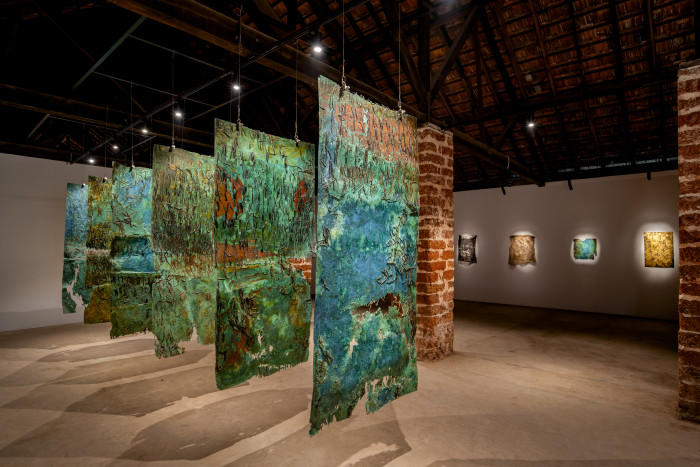
At the Kochi-Muziris Biennale, Kain presents works in tar and gold leaf, as well as a series of suspended copper plates that punctuate the viewing space. The tar canvases repeat self-citation, with each work having begun from a silicon impression of another. The result is a series of interconnected terrains, non-linear in their timeline, but with absences and oddities that are reminiscent of one another. In Mimetic 2025, the tar appears cracked like earth charred under extreme heat; in another, a terrain with similar texture is enlivened by gold leaf and red pigment over the tar. For Kain, this is not abstraction for abstraction’s sake, but rather the presentation of a unique language co-created with historical materials using her own physicality, intuition, and memory. It carries the multiplicity of Dalit inheritances and experiences, particularly those of Dalit women.
In Chronicles 2025, viewers are invited to witness the volatility and swathes of time that inscribe the series of suspended, sea-green copper plates with layers of crusting, peeling patina. Cotton lamp wicks, dipped in tar, are embedded across the plates. Here, a familiar material becomes unrecognisable in an altered context. Through heating, embedding, casting, acid exposure, or oxidation, Kain interrogates the various registers of copper—shiny, solid, brittle, and crumbling. Kain’s intuitive manoeuvring of each of these ancient materials and their potent gesture at rich, multivocal Dalit histories that are undocumented but have been passed on, at least partially, through memory, embodiment, and a relationship with the earth. Kain seeks to honour this inheritance and mark out the absences in the historical record of Dalits across India and the diaspora.
— Aparna Chivukula
View exhibition


- About
- Subscribe

